




BoostR Bracket: Versatile Solutions for Complex Framing Challenges
From wall tiebacks in hospitals and bulkheads in major office towers to stud wall head connections in data centres, the Rondo BoostR Bracket is giving our engineers more ways to solve complex framing challenges.
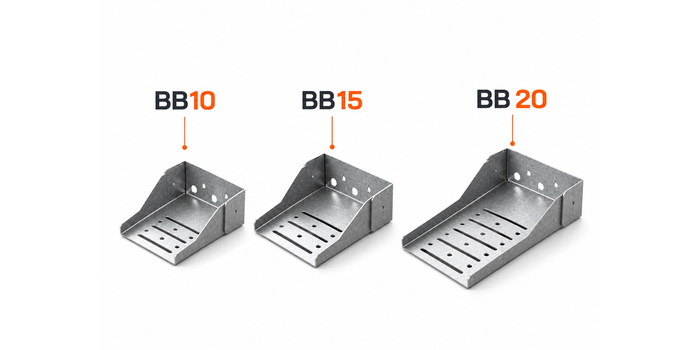
Building on its increasing use across projects, Rondo has refined the BoostR Bracket to an 85mm width, allowing it to fit within a 92mm Rondo steel stud wall framing system. The updated design provides greater installation flexibility across the BB10, BB15 and BB20 range.
What is the BoostR Bracket?
The BoostR Bracket was originally developed to provide an engineered intermediate restraint point for tall internal steel stud walls.
By introducing a restraint along the stud, the bracket reduces its effective unsupported height. This can enable taller wall designs, including applications where framing sits in front of precast concrete panels or extends beyond the slab edge.
Its strength and versatility have since led to its use in additional engineered applications, including tieback connections, bulkheads and wall head fixing details.
.
Where is the BoostR Bracket being used?
• Tall wall tiebacks at Werribee Mercy Hospital
At Werribee Mercy Hospital in Victoria, Rondo engineers incorporated the BoostR Bracket into a wall tieback design.
In suitable applications, this approach can help lightweight steel framing achieve wall heights that might otherwise require boxed studs or supplementary structural steel framing.
The result is another option for engineers seeking to meet project requirements using Rondo steel stud framing.
• Bulkhead framing at Atlassian Central
At Sydney’s Atlassian Central project, the BoostR Bracket was incorporated into a bulkhead design requiring resistance to high wind loads.
The bracket’s 1.50mm base metal thickness (BMT), combined with the specified CERT-R-FIX anchors, helped Rondo engineers achieve the load capacity required for the application.
• Non-traditional bulkhead framing across multiple Apartment & Commercial projects
Across multiple Apartment & Commercial projects, Rondo engineers have used the BoostR Bracket in non-traditional applications, including glazing headers, fascia bulkheads and sill framing.
Traditional bulkhead designs often rely on diagonal bracing, requiring sufficient bulkhead depth and space for installation. Where bulkhead depths are limited or diagonal bracing is obstructed by building services, traditional framing solutions may not be suitable, often requiring structural steel.
By incorporating BoostR Brackets into these designs, Rondo engineers have eliminated the need for diagonal bracing in suitable applications. This provides greater flexibility to design shallow bulkheads, including depths as small as 100mm, using Rondo steel framing.
The same approach has been applied to sill framing, providing alternative framing solutions while reducing the need for supplementary structural steel.
It is another example of how the BoostR Bracket is giving Rondo engineers more ways to solve complex framing challenges across a range of applications.
• Steel Stud Wall head connections for multiple data centres
Rondo engineers have also specified the BoostR Bracket in fire-rated stud wall head fixing details for data centre projects, including BB10 connections to purlins.
These details are developed for each project, taking into account the framing connection and the requirements of the nominated wall system.
.
What sizes are available?
All three BoostR Brackets feature the refined 85mm width and 1.50mm BMT. Rondo engineers select the appropriate bracket size and fixing arrangement to suit the application and project-specific design requirements.
Part number | Width | Height | BMT |
BB10 | 85mm | 100mm | 1.50mm |
BB15 | 85mm | 150mm | 1.50mm |
BB20 | 85mm | 200mm | 1.50mm |
.
What are the benefits of the BoostR Bracket?
Depending on the engineered application, the BoostR Bracket can provide:
• Greater installation flexibility: The refined 85mm width fits within a 92mm Rondo wall framing system.
• Increased wall heights: Intermediate restraint can reduce the effective unsupported stud height.
• Alternative framing solutions: Suitable designs may reduce the need for boxed studs or supplementary structural steel.
• Versatility across applications: Options include tall wall restraints, tieback connections, bulkheads and selected wall head fixing details.
• Project-specific engineering: Bracket selection and connection details are developed to suit the loads and requirements of each project.
.
How are BoostR Brackets installed?
BoostR Brackets are installed in accordance with the project’s Rondo engineered design and the instructions outlined in the Rondo BoostR Bracket Tech Brief.
The engineered design specifies the bracket size, fixing positions, anchors and screws required. As fixing configurations have different capacities, following the specified connection details is essential to achieving the required performance.
Unlike the BB10 and BB15, the BB20 is supplied slightly open to provide tool access when installing the specified Rondo CERT-R-FIX anchors. Once the anchors are installed the bracket is returned to a 90-degree angle and secured through the aligned side holes before connection to the framing, as detailed in the installation instructions.
Download the BoostR Bracket Tech Brief for fixing configurations and detailed installation guidance.
.
How can I include BoostR Brackets in my Rondo NEXUS engineered design?
Rondo engineers assess where BoostR Brackets can add value and incorporate them into suitable project designs.
• If you purchase through a Rondo distributor, speak with our distribution partner about submitting a project design request through their Rondo Account Manager.
• If you purchase directly from Rondo, speak with your Rondo Account Manager when submitting your design request.
Find out how the BoostR Bracket could support your next project. Contact your Rondo Account Manager or distribution partner to discuss your requirements and submit a design request.