

DOWNLOAD THE FULL ARTICLE HERE
The Real Cost of Cutting Corners: Corrosion Discovered in a Building Less Than Five Years Old
Steel framing may be concealed once the plasterboard is installed, but poor-quality steel has a way of revealing itself, often when the cost of fixing it is at its highest.
Rondo was recently contacted to inspect a project completed less than five years ago. A certifier had requested that sections of the internal wall and ceiling linings be removed so the concealed steel framing could be examined.
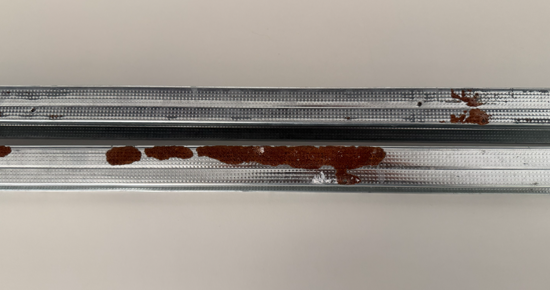
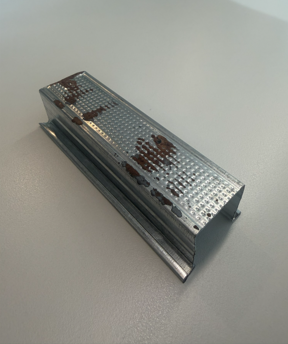
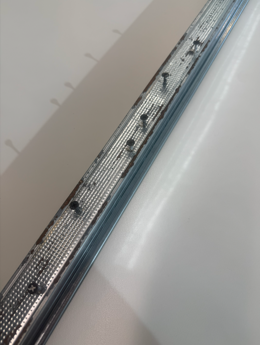
When the plasterboard was removed, rust was clearly visible on the imported steel framing behind it.
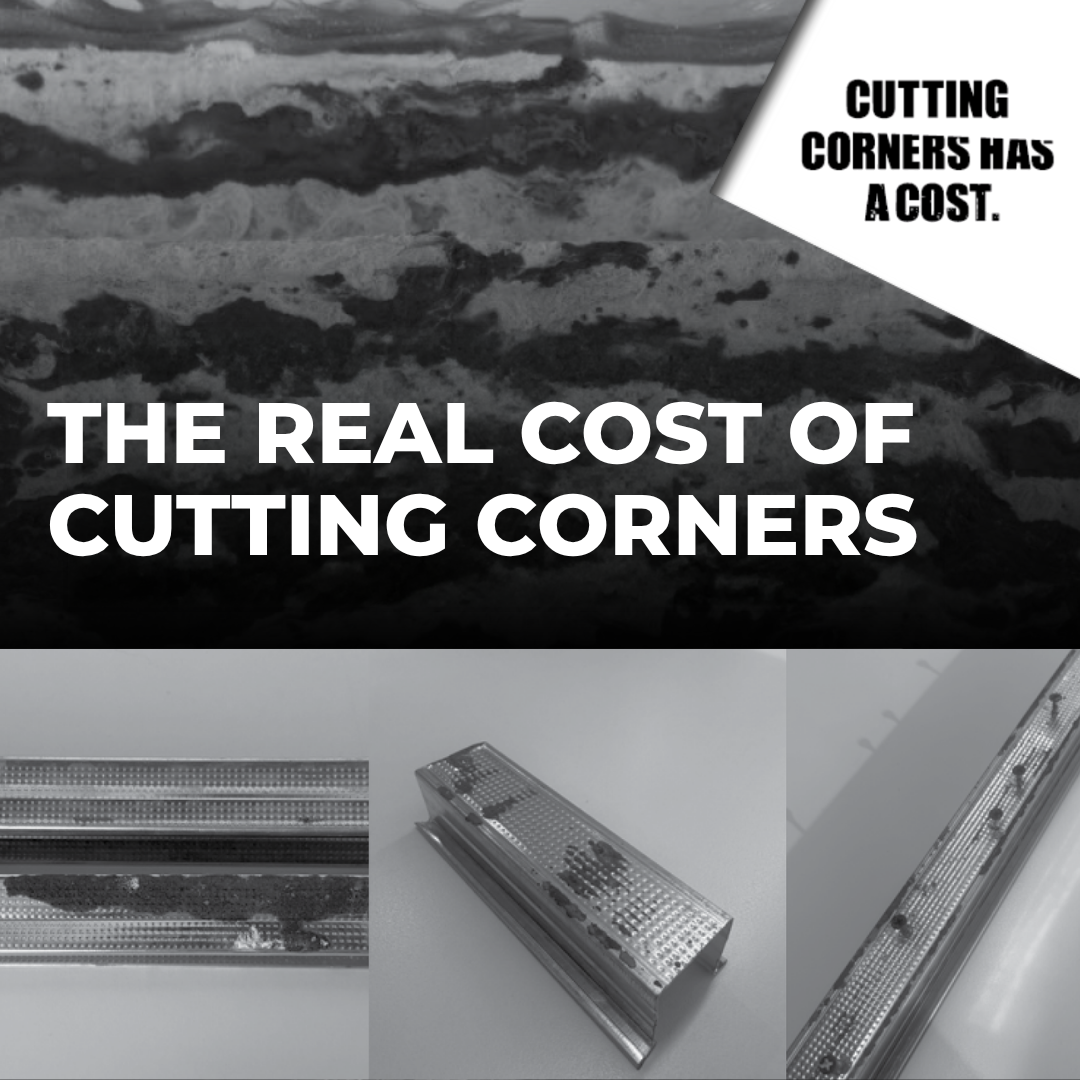
This build provides another powerful real-time example of a message at the heart of Rondo’s Cutting Corners campaign: low cost imported steel products may create far greater costs later.
What did the Laboratory Testing Reveal?
Samples of the corroded furring channel and steel stud were sent to an independent laboratory to determine their zinc coating mass.
The results were concerning:
The furring channel had a zinc coating mass of just 23 g/m².
The steel stud had a zinc coating mass of only 102 g/m².
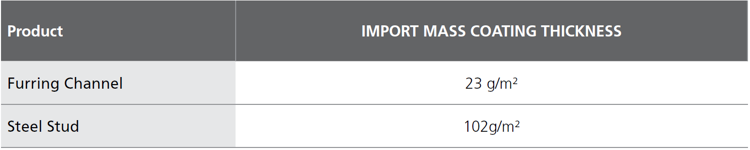
For comparison, Rondo Furring Channel and Steel Stud are produced from steel with a Z275 coating, providing a coating mass of 275 g/m².
This means the tested furring channel had less than one-tenth of the zinc coating mass used on the equivalent Rondo product. It is also well below the informative recommendation of AS/NZS 2785 to be a minimum of Z180 for internal ceilings. The tested steel stud had little more than one-third.
That difference matters because the zinc coating protects the steel from corrosion. The less zinc there is, the less protection the steel has against moisture and environmental conditions, even when it is used in internal walls and ceilings, as it was on this project.
As a reference, our Materials Engineers estimate that red rust may appear within 6 months of exposure of this furring channel in a relatively mild (C3) corrosion zone.
From Accelerated Testing to a Real-World Building
As part of Rondo’s extensive Cutting Corners investigation, imported steel products were collected and tested to assess their coating mass, material properties and durability. Many of the imported products examined were typically supplied with a Z100 zinc coating.
Accelerated salt spray testing demonstrated a clear difference in performance. Red rust appeared on imported steel samples within 200 hours, with significant corrosion evident by 400 hours. Rondo samples showed no visible red rust over the same testing period.
Laboratory testing is important because it allows products to be compared under controlled conditions. This latest project takes the issue beyond the laboratory, showing what an inferior zinc coating can mean inside a relatively new building.
In less than five years, corrosion had already developed within concealed internal walls and ceilings.
A Small Saving can Become a Major Rectification Cost
The affected walls and ceilings will now need to be pulled out. The imported framing will be removed and replaced with Rondo metal framing before the areas can be relined, replastered and repainted.
This is not a cheap or simple exercise. It consumes time, labour and materials, while also creating disruption for the building owner and potential reputational consequences for the businesses involved.
Costs that could have been avoided if Rondo products had been specified, supplied and installed from the beginning.
Costs of Replacing Corroded Steel
Time
Labour
Materials
Reputation
Product Substitution can Remain Hidden
Once walls and ceilings are lined, it can be difficult to confirm which framing products were installed. An imported product may look similar, but appearance alone does not demonstrate equivalent coating mass, durability or performance.
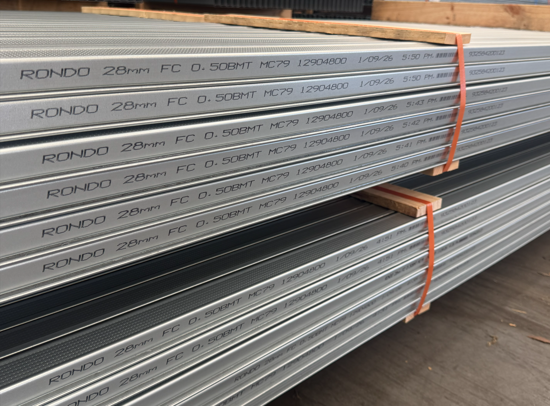
Rondo metal products are inkjet printed and our clips are stamped with the Rondo brand, providing clear product identification and helping builders, contractors, installers and certifiers verify that genuine Rondo products have been supplied and installed.
This identification is particularly important when products will ultimately be concealed behind plasterboard. Checking for the Rondo inkjet branding before linings are installed provides confidence that the specified product is being used and helps protect against unapproved substitution.
Everyone involved in a project can use Rondo’s inkjet branding to help reduce risk:
Specifiers can require Rondo’s inkjet branding as a simple way to confirm the specified products have been supplied.
Builders can verify the inkjet branding when materials arrive on site and before walls and ceilings are lined with plasterboard.
Installers can check for the Rondo name before installing the framing and again before it is concealed behind plasterboard.
Certifiers can use the visible branding to help confirm that genuine Rondo products have been installed before the walls and ceilings are lined.
A framing product should not be accepted as equivalent simply because its dimensions or appearance seem similar. Look for the Rondo name inkjet printed or stamped on the metal product or clip to verify that genuine Rondo metal products have been supplied.
Protect The Building and Your Reputation
The consequences of cutting corners extend well beyond the original material saving. When an inferior product fails, the cost can include destructive investigation, extensive rectification, project delays, disputes and damage to hard-earned reputations.
The steel framing behind a wall or ceiling might not be visible when a project is complete, but its quality continues to matter throughout the life of the building.
This is another case that demonstrates why the lowest upfront price may ultimately be the most expensive choice.
Specify Rondo and Verify Rondo on your Project.
Learn more about Rondo’s Cutting Corners investigation and the performance differences identified through its extensive product testing: Explore the Cutting Corners investigation.
Explore Edition 1 and 2 of our Cutting Corners Campaign for Further Insight on the Full Investigation:
Edition 1: Investigation Into Imported Steel Products